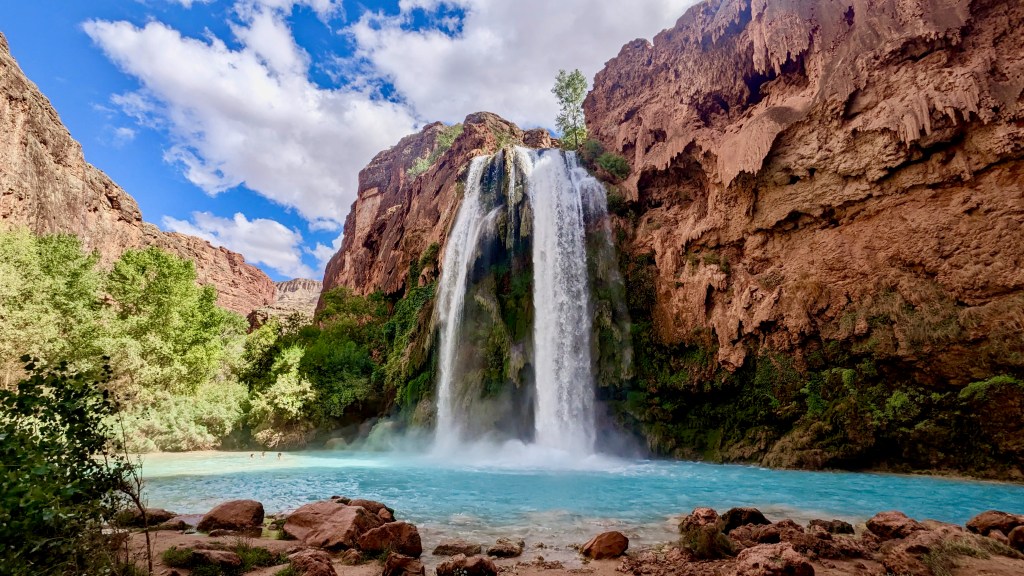
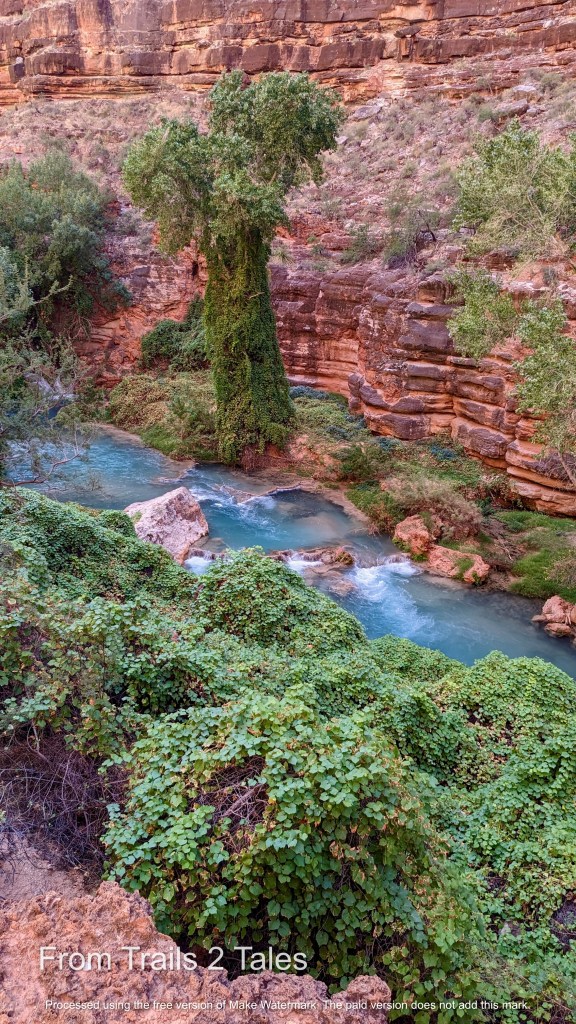
Hidden deep down in the Grand Canyon there is a blue-green creek that flows through deep, red canyon walls. Along the way, this creek drops almost 100 feet to make Havasu Falls (Havasu means blue-green water). Havasu Falls is a highly coveted destination and is widely photographed, but there are actually five main waterfalls in this area: Navajo Falls, Fifty Foot Falls, Havasu Falls, Mooney Falls and Beaver Falls. I am going to go against popular opinion here and say that Havasu Falls wasn’t my favorite, but it was spectacular nevertheless. Keep reading below to find out which waterfall was my favorite!
Table of Contents
- The Waterfalls of Havasu Canyon
- Supai Village & the History of Havasu
- Obtaining a Permit
- When to Visit
- Getting There
- Where to Stay
- Tips for your Visit
The Waterfalls of Havasu Canyon
Havasu Falls
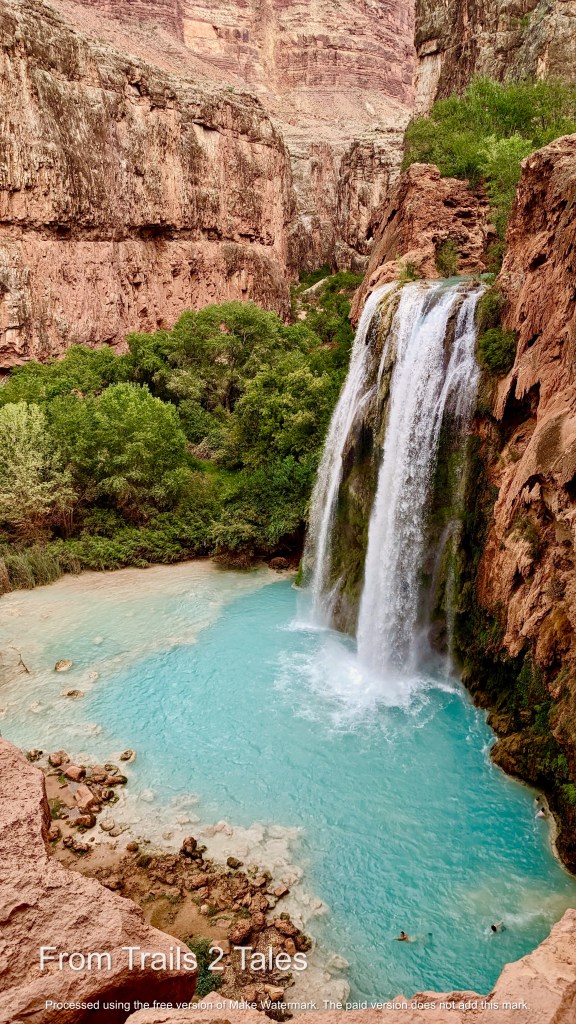

Havasu Falls is approximately 100 feet tall and it forms several pools that make for excellent swimming at the base. This waterfall is at the start of the Havasupai Campground and is a refreshing site after 10 miles of hiking. If you’re lucky enough you’ll be able to enjoy freshly made fry bread sold by the villagers at a stand at the top of the falls. There are also a few trees here to set up a hammock and relax while watching the waterfall.
Mooney Falls
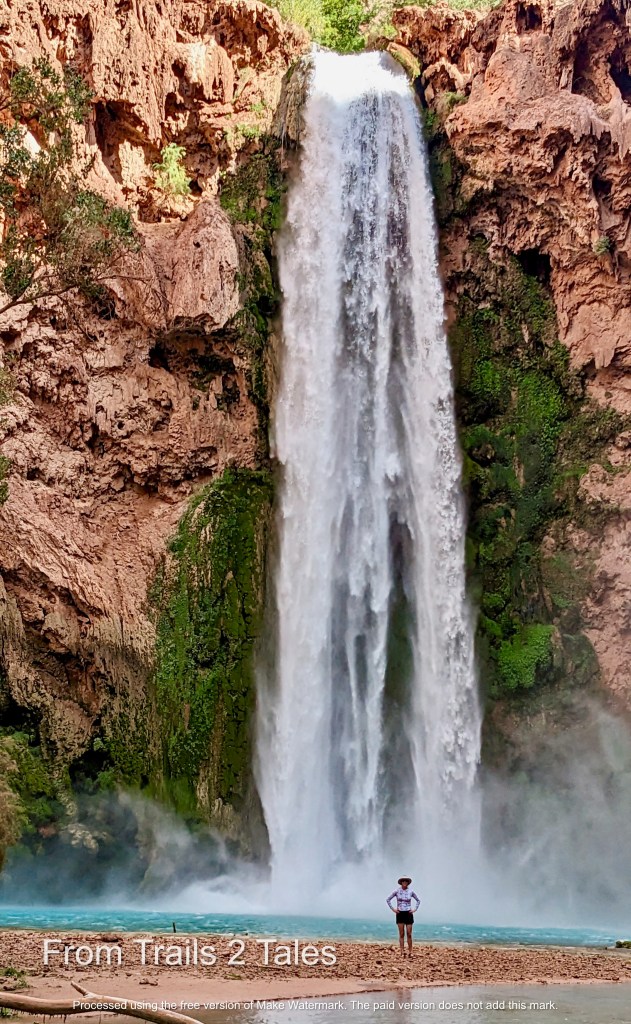
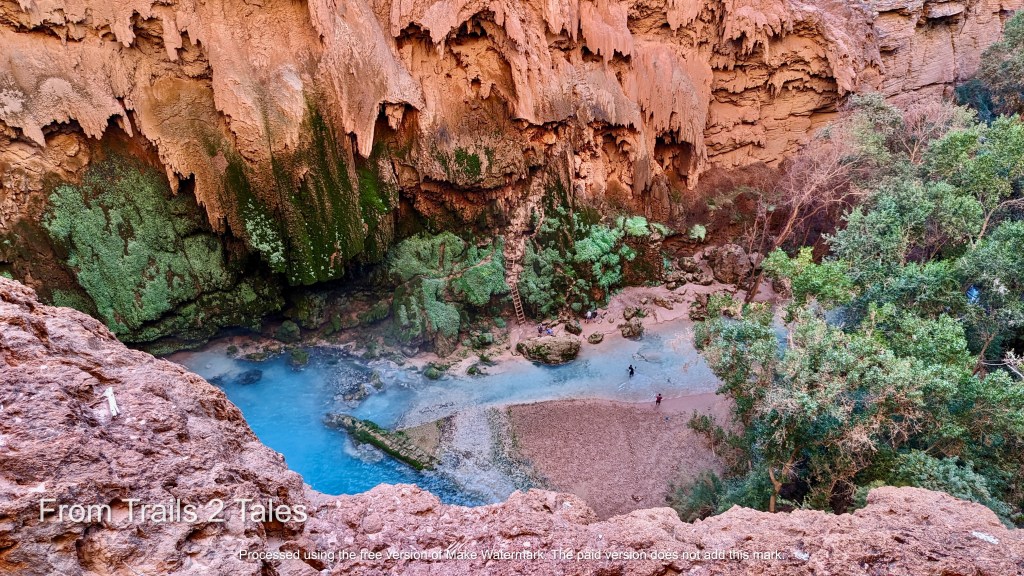
The waterfall that you will encounter at the end of the campground, and my personal favorite, is Mooney Falls. Mooney falls is twice the height of Havasu falls. From the top, you can look out over a breathtaking canyon where the red rocks, lush green foliage and blue-green water really pop. At the bottom, you will be sprayed by the mist of the falls, which can be a welcome cool off on a hot day. Mooney Falls does not necessarily have the pools that Havasu Falls does, but there are plenty of spots here for wading. I don’t suggest getting too close to the waterfall itself though.
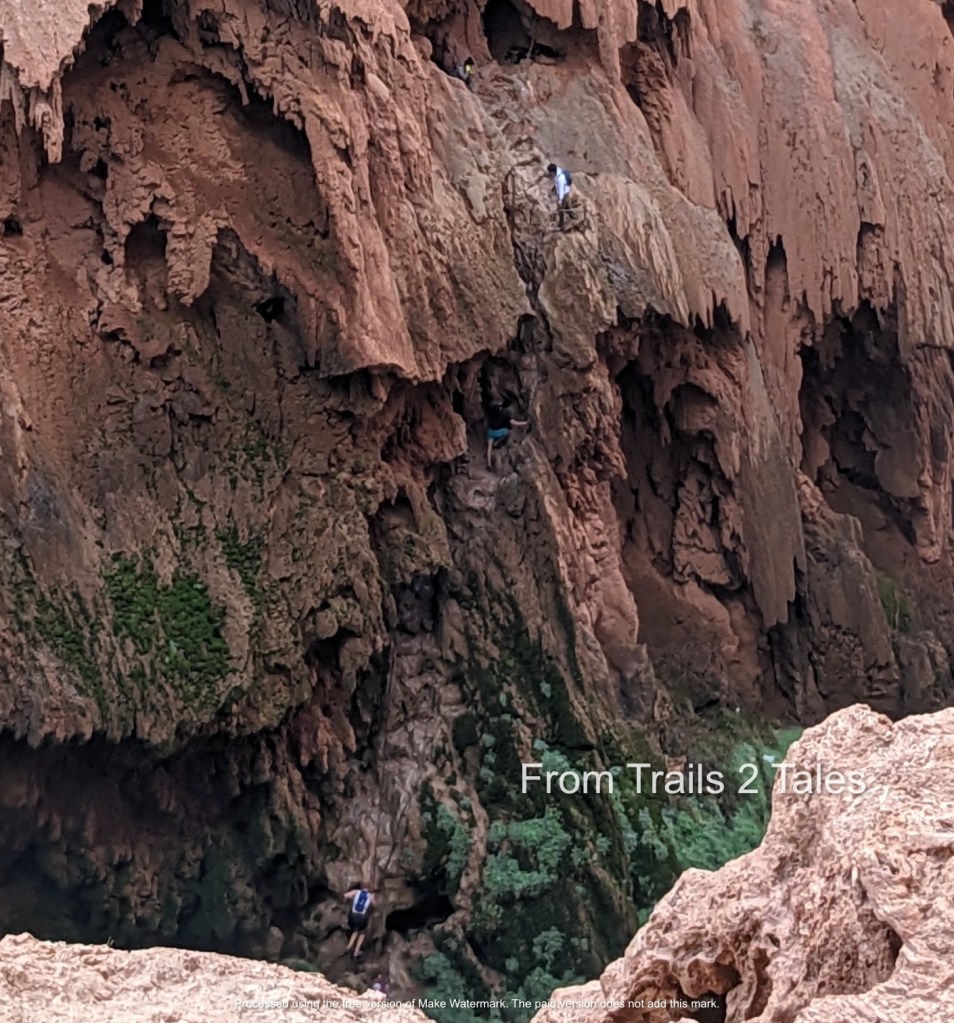
Probably the most exhilarating part of Mooney Falls is the trip you must take in order to view the falls from the bottom and also to continue on to Beaver Falls. This descent is not for the faint of heart. I am fairly used to exposure while hiking and this got my heart racing. To reach the bottom, you will have to descend 200 feet first through a short cave, and then down ‘steps’ worn into the rock with thick metal chains to hold on to. This section is highly exposed and would be quite dangerous without the metal cables. There might even be a pile of gloves that people use and leave at the top and/or bottom when they are finished. Close to the bottom, you will climb down several ladders. The whole time you are being sprayed by mist from the waterfall, which also makes the steps and cables wet and slippery. As long as you go slowly and always maintain three points of contact, this is doable. I saw individuals of all ages and fitness make the descent. And, it is absolutely worth it.
Beaver Falls
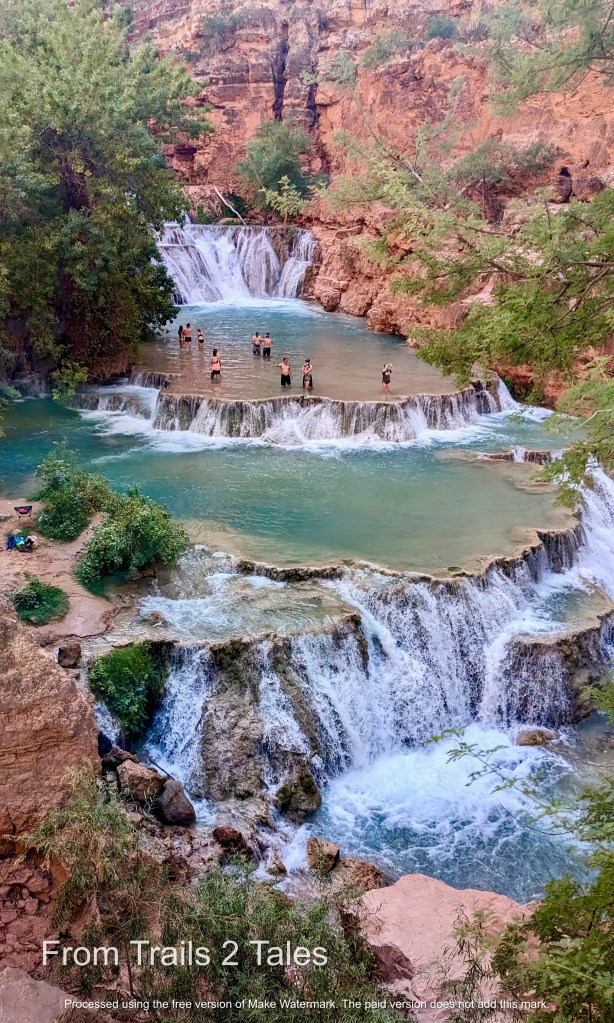
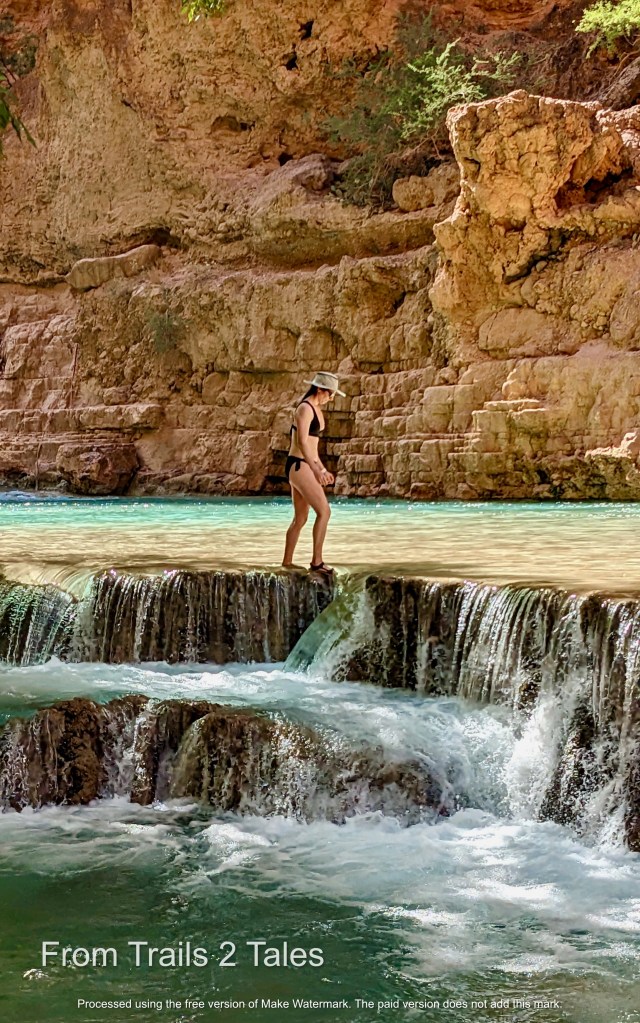
Beaver Falls is approximately 6 miles round trip from Mooney Falls. This stretch of trail was probably my favorite. The red canyon walls narrowed here, allowing views of the blue-green waters of Havasu creek the entire way. The foliage also grew quite thick and at times provided a shaded canopy overhead. Along this trail you will encounter several creek crossings as well as more ladders secured to the walls; in other words, the adventurous descent from Mooney Falls continues through here! You may even spot a small group of bighorn sheep that live in this canyon.
Beaver Falls themselves consist of multiple stepped waterfalls that coalesce into pools at the bottom. It is possible to wade up to the higher pools and enjoy the views from there.
Fifty Foot Falls
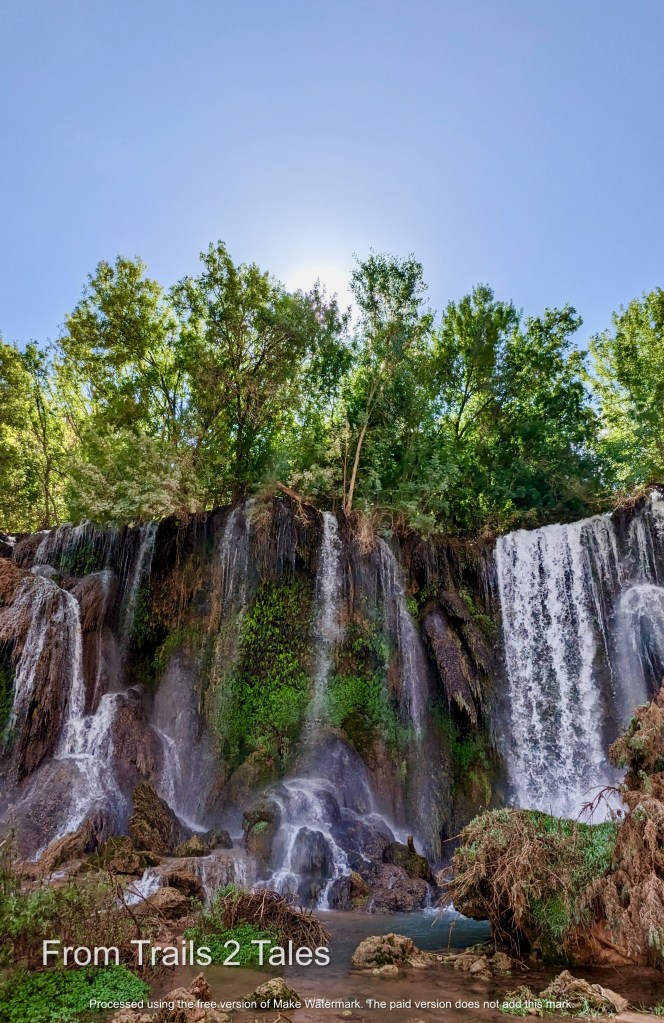
Fifty Foot Falls are the first set of waterfalls you will pass on your way out of Supai village. However, they are mostly obscured from the trail and getting to them is not straight-forward. I found them by following a trail near the first set of pit toilets that you pass beyond Supai. You will have to duck under thick bushes and wade through thigh-high water to reach them. Because of this, fewer people make the trek to see Fifty Foot Falls.
Little Navajo Falls
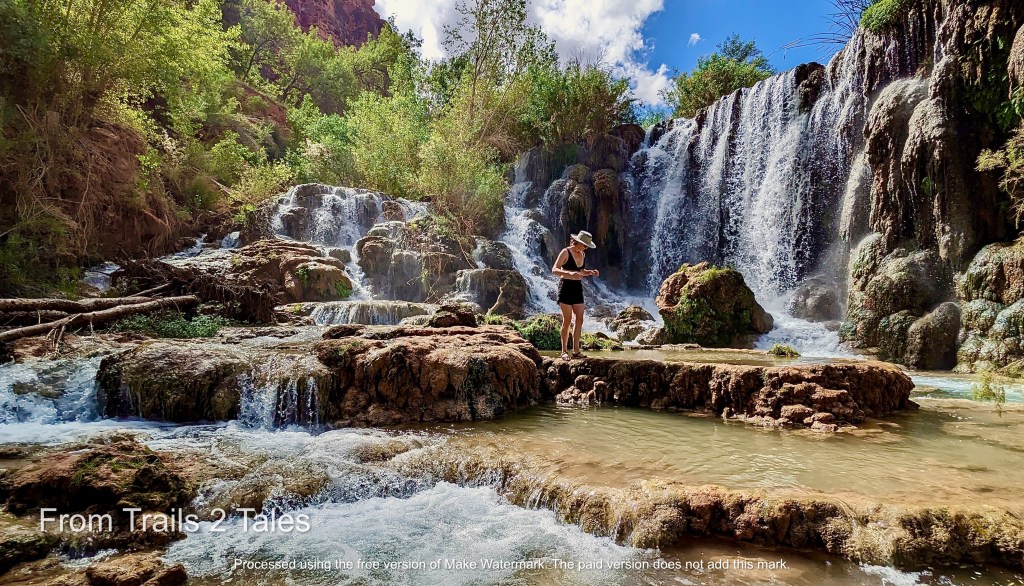
Little Navajo Falls is the second set of falls that you’ll pass after leaving Supai Village. These require a little bit of scrambling down off the main trail to reach and also provide several great wading pools both above and below the falls.
Supai Village & the History of Havasu
Adding to the mystery of this location, Havasu Falls sits on the Havasupai (people of the blue-green water) Indian Reservation. The Havasuapi have called this place their home for over 1000 years. To access the falls and campground, you will pass through Supai Village. It is prohibited to photograph or take video anywhere in this village, and the Havasupai ask that you also don’t take photo or video of them, their horses or buildings. Tourism is a large part of their economy and they work hard to keep this place clean and functioning for the enjoyment of tourists, so please show respect in return and also practice Leave no Trace principles.
I encourage striking up a conversation with the locals when you visit as they enjoy sharing about their community. They also run a small grocery store, post office, tourist office and restaurant for visitors. You can stock up on some supplies here and enjoy food that you don’t have to prepare yourself! We stopped at the restaurant on our way in for a quick break to cool off and refuel. I felt that the food and supplies were reasonably priced. In addition, there is a fry bread stand at the top of Havasu Falls that is run by the villagers, though their hours are not posted or consistent. Fry bread is a specialty of Native Americans and is a flat dough bread that is fried and served with savory or sweet condiments. If they happen to be open when you pass by, enjoy some fry bread and take extra for the rest of your stay as they might not be open the next time!
Obtaining a Permit
To visit Havasu Falls, you must obtain a permit through the Havasupai Tribe. The official website to reserve a permit and to find more information can be found here. As of this writing, obtaining a permit allows for a four-day, three-night stay. Only 350 people are allowed per night, and these permits go fast! Reservations for the upcoming year open in February of that year. If you miss this initial opening, you can also check out the cancellation/transfer list on a daily basis to see if any permits become available. My experience was that several options for permits became available every day, but they would be booked within seconds, so you have to be quick!
When to Visit
Fall and spring might be the best seasons to visit Havasu. The temperature is mild enough for hiking, but still warm enough for swimming. The official website says that the water temperature stays roughly at 70ºF year-round, but since it is moving it can feel a bit cooler. In the summer, the daily temperature can quickly go over 100ºF. In the winter, nighttime temperatures can go below 40ºF, which can make for a cold night. I visited in early October, with highs in the 70s and lows in the 50s. Hiking was quite comfortable and I was able to swim in the water for a good amount of time. However, if it was a cloudy day I found myself getting a bit chilled at times in the water. I would always carry an extra set of dry clothes to change into just in case.
Getting There
Once you have your permit and are packed and ready, you’ll make your way to Hualapai Hilltop, which is just northeast of Peach Springs, Arizona. (Do note that you may have to stop at Grand Canyon Caverns & Inn in Peach Springs to check in with the Havasu Tourist Office. Again, check the official website for more information.) This is where you will leave your car and begin the journey down in to Havasu Canyon. From Hualapai Hilltop, it is about 8 miles to Supai Village where the lodge is, and then another two miles to the campground. Hualapai Hilltop is at 5,200 feet of elevation, while Supai Village is at 3,205 feet and Havasupai Falls Campground is at 2,800 feet. There will be a total elevation loss of about 2,400 feet from the Hilltop to the campground.
There are a few options for traveling this distance: 1) hike in and carry your pack with you; 2) hire a pack animal provided by and led by the Havasupai Tribe to carry your pack; 3) ride one of said pack animals yourself; 4) take a helicopter that flies as far as Supai Village. To learn more about these options, refer to the official Havasupai Reservations website.
Where to Stay
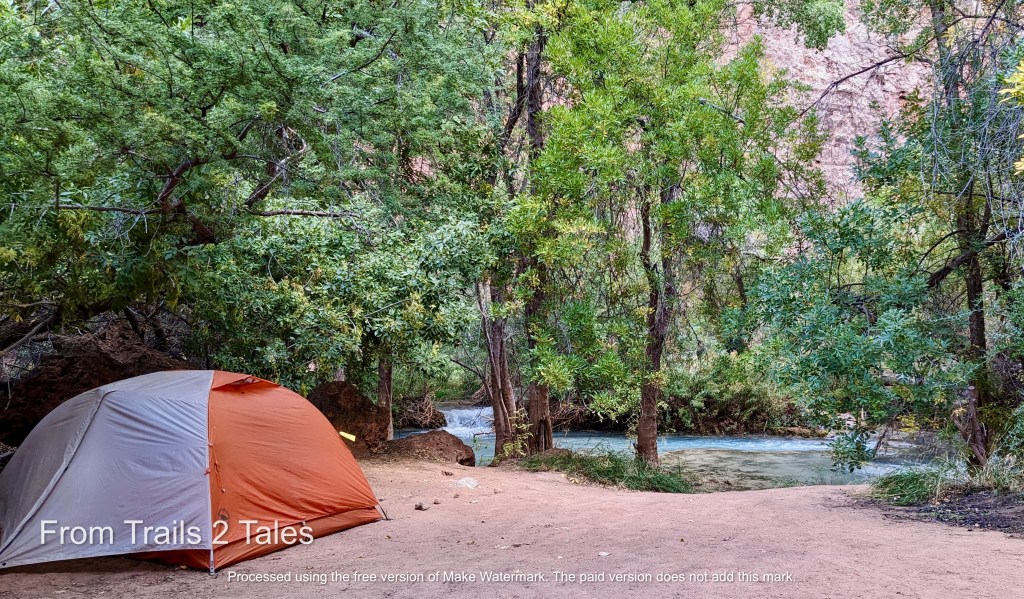
There are two options for lodging in Havasu Canyon. You can either stay in the lodge within Supai Village, or you can stay at the campground just past the village. There are few spots available at the lodge and it is an additional cost beyond the permit. The campground stretches for roughly a mile between Havasu Falls and Mooney Falls. There are plenty of trees in this area and the majority of campsites will offer shade along with the steep canyon walls. There are no designated sites, but it is easy to tell where people tend to set up camp.
The campground offers picnic tables that appeared in most cases to be shared between two campsites. There are outhouses at the beginning, middle and end of the campground that may or may not have toilet paper. A natural spring can be found close to the beginning of the campground to fill up on water. It is recommended to bring a bag to hang your food or bear canister to keep your food safe from critters.
As a word of warning, if you cannot tolerate camping nearby other people, this may not be the trip for you. As I mentioned there are 350 permits per night. That means 350 people along a one-mile stretch of land through a canyon that is not very wide. You will be around many people. As long as you know this going in, you can prepare yourself. We arrived later in the day on our hike in and ended up having to hike to the other end of the campground to find a decent spot. In spite of that, I was quite surprised by the spot that we found which offered a picnic table, shade, tree to set up a hammock (highly recommended!) and a fair amount of privacy. In fact, I might even say that the end of the campground near Mooney Falls might be the best option for camping. It felt a bit quieter here and also offered the best views. There is a spectacular view from the top of Mooney Falls down into Havasu Canyon in this area, which is beautiful at sunset and sunrise.

Also, be prepared to throw a Leave no Trace principle out the window when it comes to camping no closer than 200 feet next to a stream. At least half of the campsites are within a few feet of Havasu Creek; even more reason to keep a tidy camp and make diligent use of the outhouses.
Tips for your Visit
- Bring water shoes for the man river crossings and to protect your feet when wading in the pools
- A hammock is a great option to rest and stare up at the stars at night. A lot of the campsites have trees nearby so you should be able to find a place to hang.
- A bear canister or rope to hang food is recommended due to small animals in the area.
- Since the rock walls in the canyon are narrow and steep, plan your visits to the waterfalls depending on whether you want sun or shade for phots and/or warmth. In October, the sun was shining down on the waterfalls from about 10 am to 3 pm.
- Bring a day pack for your daily trips. You might leave your camp in the morning and not be back until late afternoon.
 From Trails 2 Tales
Leave a comment